La « forêt », ma « forêt » telle que je l’ai pensée et réalisée, est une installation protéiforme, ludique, qui incite à la rêverie et au lâcher prise. A l’image d’une forêt d’arbres, où chacun d’eux semble investir l’espace de façon anarchique, mes arbres sont comme des kakémonos suspendus à une vaste toile d’araignée, épousant le relief qui s’offre à eux. Chaque encre est suspendue par un axe central qui lui permet de tourner sur elle-même au moindre souffle d’air ou rencontre fortuite avec un spectateur rêveur. Rien ne les retient au sol, donnant libre court aux mouvements les plus ténus comme aux plus amples.
En septembre 2016 j’ai eu la chance de pouvoir visiter au Kanagawa Arts Theater de Yokohama l’exposition « The locked room » de l’artiste japonaise Chiharu Shiota. J’ai beaucoup aimé ce travail constitué d’un nombre incalculable de ficelles rouges nouées entre elles et reliées du sol au plafond pour former une immense toile d’araignée au milieu de laquelle les visiteurs pouvaient se promener en totale immersion. C’est précisément ce côté immersif qui m’a beaucoup plu et que j’ai souhaité reproduire dans cette exposition du Sépulcre. Paradoxalement en traversant l’œuvre nous nous retrouvions physiquement ailleurs, hors du bâtiment qui l’abritait. On retrouve cette sensation avec la littérature à la différence qu’ici c’est une sensation sensorielle et non purement intellectuelle.
C’est à la suite de cette exposition que j’ai réalisé ma première forêt en 2017 au Sépulcre à Caen. Cela allait devenir récurrent dans mon travail exposé.
Cette première forêt, avec ses quelques quarante-cinq arbres-encre, réalisés sur de la toile de verre transparente, suspendus en leur centre, comme des kakemonos, permettait aux visiteurs de s’y frayer un chemin et d’avoir ainsi la sensation de sortir de l’exposition et du bâtiment. Ce sentiment d’évasion était renforcé par le léger mouvement des encres-arbre, conjugué avec les effets de lumière et de transparence en provenance des vitraux inondés par les rayons du soleil. J’ai réalisé des vidéos en plan fixe, témoins de cette téléportation sensorielle. Ces vidéos nous montrent avec une grande acuité toute la richesse et la complexité de l’installation. Le léger souffle, traversant en continu la forêt, rebondit sur chaque arbre avec des effets de rotation de l’encre autour de son axe central, mais aussi de balancement qui se conjuguent. Le déplacement d’un arbre provoque/agit sur celui, concomitant, de ses voisins. Il en découle un ballet d’une lenteur apaisante dont la chorégraphie, bien que très difficilement compréhensible, n’en est pas moins très perceptible, car elle met en place des motifs récurrents.
En approchant les bords extérieurs de la forêt, la transparence des encres-arbre permettait de découvrir le reste de l’exposition.
Un autre élément remarquable des forêts est qu’elles ont de l’effet sur tous les publics, des plus jeunes aux plus âgés. J’ai pu le constater à de nombreuses reprises comme ce fut le cas en 2020 à l’école Louis Aragon de Giberville (14), en 2022 à l’école Odette du Puigaudeau à Dakhla au Maroc ou encore dans mes expositions classiques.
The ‘forest’, my ‘forest’ as I have conceived and created it, is a protean, playful installation that encourages you to dream and let go. Like a forest of trees, each of which seems to occupy the space in an anarchic fashion, my trees are like kakemonos suspended from a vast spider’s web, following the contours of the landscape. Each ink is suspended by a central axis that allows it to turn on itself at the slightest breath of air or chance encounter with a dreamy spectator. Nothing holds them to the ground, giving free rein to the most tenuous and the most sweeping movements.
In September 2016, I was lucky enough to be able to visit the Kanagawa Arts Theater in Yokohama to see the exhibition “The locked room” by Japanese artist Chiharu Shiota. I really liked this work, which consisted of countless red strings tied together and linked from floor to ceiling to form an immense spider’s web, in the middle of which visitors could walk in total immersion. It was precisely this immersive aspect that I liked so much and that I wanted to reproduce in this exhibition at Le Sépulcre. Paradoxically, as we walked through the work, we found ourselves physically elsewhere, outside the building that housed it. That’s the same feeling you get with literature, except that here it’s a sensory sensation rather than a purely intellectual one.
It was following this exhibition that I made my first forest in 2017 at Le Sépulcre in Caen. It was to become a recurring theme in my exhibited work.
This first forest, with its forty-five or so ink-trees, made on transparent glass canvas, suspended in the centre, like kakemonos, allowed visitors to make their way through it and thus have the sensation of stepping outside the exhibition and the building. This sense of escape was reinforced by the slight movement of the tree inks, combined with the effects of light and transparency coming from the stained glass windows flooded by the sun’s rays. I shot a series of still videos to capture this sensory teleportation. These videos show us with great acuity all the richness and complexity of the installation. The gentle breeze, blowing continuously through the forest, bounces off each tree with the combined effects of the ink’s rotation around its central axis and its swaying. The movement of one tree causes/acts on the concomitant movement of its neighbours. The result is a ballet of soothing slowness whose choreography, although very difficult to understand, is nonetheless very perceptible, because it sets up recurring motifs.
As we approached the outer edges of the forest, the transparency of the tree inks revealed the rest of the exhibition.
Another remarkable thing about forests is that they have an effect on all audiences, from the youngest to the oldest. I’ve been able to see this on numerous occasions, as was the case in 2020 at the Louis Aragon school in Giberville (14), in 2022 at the Odette du Puigaudeau school in Dakhla, Morocco, or at my classic exhibitions.
La “foresta”, la mia “foresta” come l’ho concepita e creata, è un’installazione proteiforme e giocosa che incoraggia a sognare e a lasciarsi andare. Come una foresta di alberi, ognuno dei quali sembra occupare lo spazio in modo anarchico, i miei alberi sono come kakemonos sospesi da una vasta ragnatela, che segue i contorni del paesaggio. Ogni inchiostro è sospeso da un asse centrale che gli permette di girare su se stesso al minimo soffio d’aria o all’incontro casuale con uno spettatore sognatore. Nulla li trattiene a terra, dando libero sfogo ai movimenti più tenui e a quelli più ampi.
Nel settembre 2016 ho avuto la fortuna di poter visitare il Kanagawa Arts Theater di Yokohama per vedere la mostra “The locked room” dell’artista giapponese Chiharu Shiota. Mi è piaciuta molto quest’opera, che consisteva in innumerevoli corde rosse legate tra loro e collegate dal pavimento al soffitto a formare un’immensa ragnatela, in mezzo alla quale i visitatori potevano camminare in totale immersione. Era proprio questo aspetto immersivo che mi piaceva tanto e che volevo riprodurre in questa mostra a Le Sépulcre. Paradossalmente, mentre camminavamo attraverso l’opera, ci trovavamo fisicamente altrove, fuori dall’edificio che la ospitava. È la stessa sensazione che si prova con la letteratura, ma in questo caso si tratta di una sensazione sensoriale e non puramente intellettuale.
È stato in seguito a questa mostra che ho realizzato la mia prima foresta nel 2017 presso Le Sépulcre a Caen. Sarebbe diventato un tema ricorrente nelle mie opere esposte.
Questa prima foresta, con i suoi circa quarantacinque alberi d’inchiostro, realizzati su tela di vetro trasparente, sospesi al centro, come kakemonos, permetteva ai visitatori di farsi strada attraverso di essa e di avere così la sensazione di uscire dalla mostra e dall’edificio. Questo senso di evasione era rafforzato dal leggero movimento degli inchiostri degli alberi, unito agli effetti di luce e trasparenza provenienti dalle vetrate inondate dai raggi del sole. Ho girato una serie di video fissi per catturare questo teletrasporto sensoriale. Questi video ci mostrano con grande acutezza tutta la ricchezza e la complessità dell’installazione. La brezza leggera, che soffia continuamente attraverso la foresta, rimbalza su ogni albero con gli effetti combinati della rotazione dell’inchiostro intorno al suo asse centrale e del suo ondeggiamento. Il movimento di un albero causa/agisce sul movimento concomitante dei suoi vicini. Il risultato è un balletto di rilassante lentezza la cui coreografia, sebbene molto difficile da capire, è comunque molto percepibile, perché stabilisce motivi ricorrenti.
Avvicinandoci ai margini esterni della foresta, la trasparenza degli inchiostri degli alberi ha rivelato il resto della mostra.
Un’altra cosa notevole delle foreste è che hanno un effetto su tutti i pubblici, dai più giovani ai più anziani. Ho potuto constatarlo in numerose occasioni, come nel 2020 alla scuola Louis Aragon di Giberville (14), nel 2022 alla scuola Odette du Puigaudeau di Dakhla, in Marocco, o nelle mie mostre classiche.
Espace Saint-Nicolas, Coutances (2024)
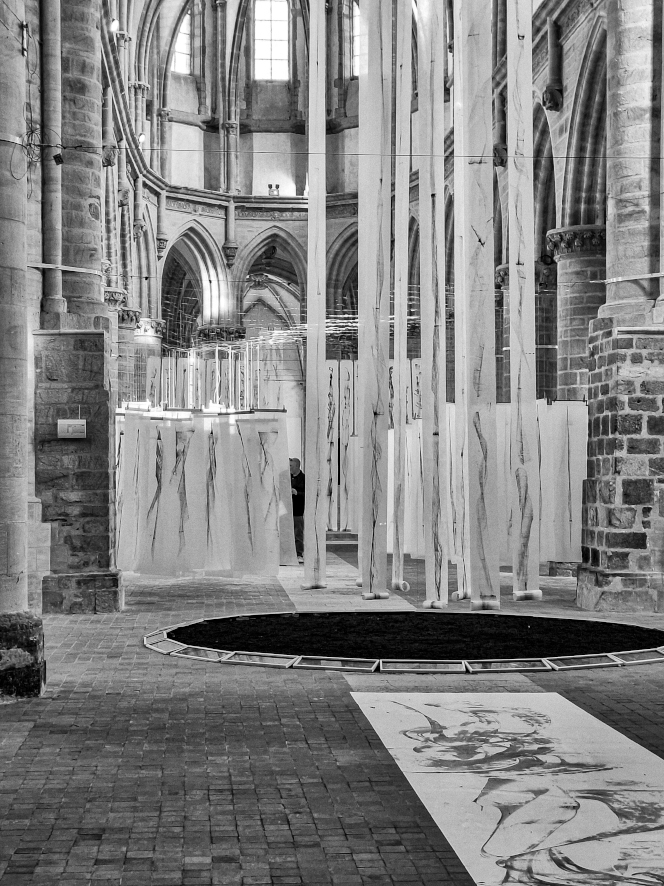
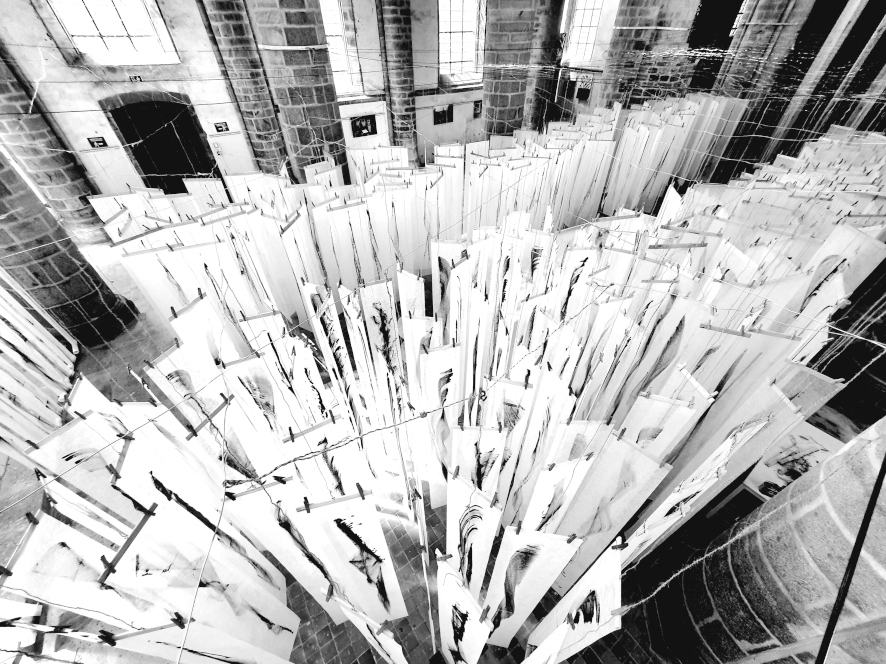
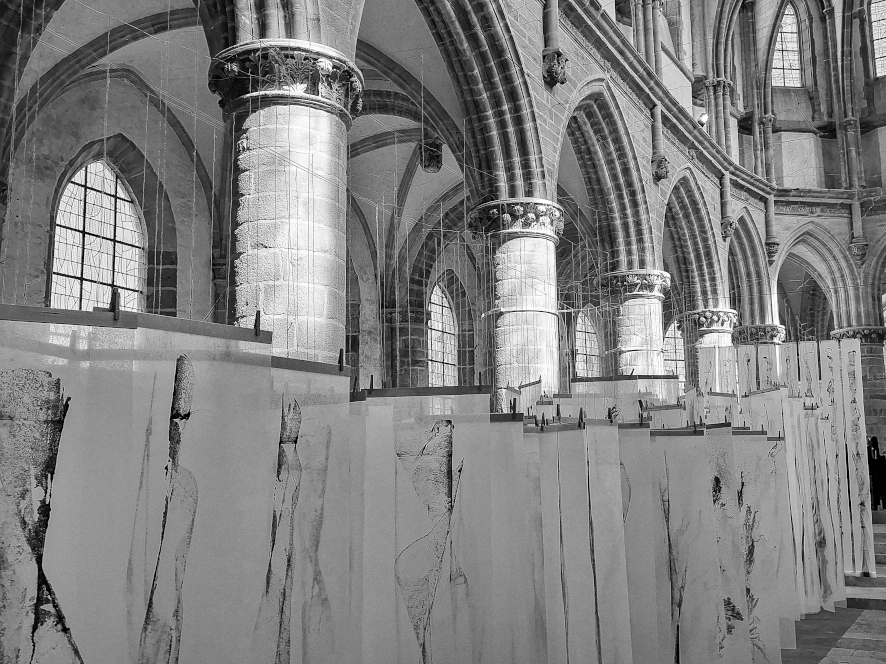
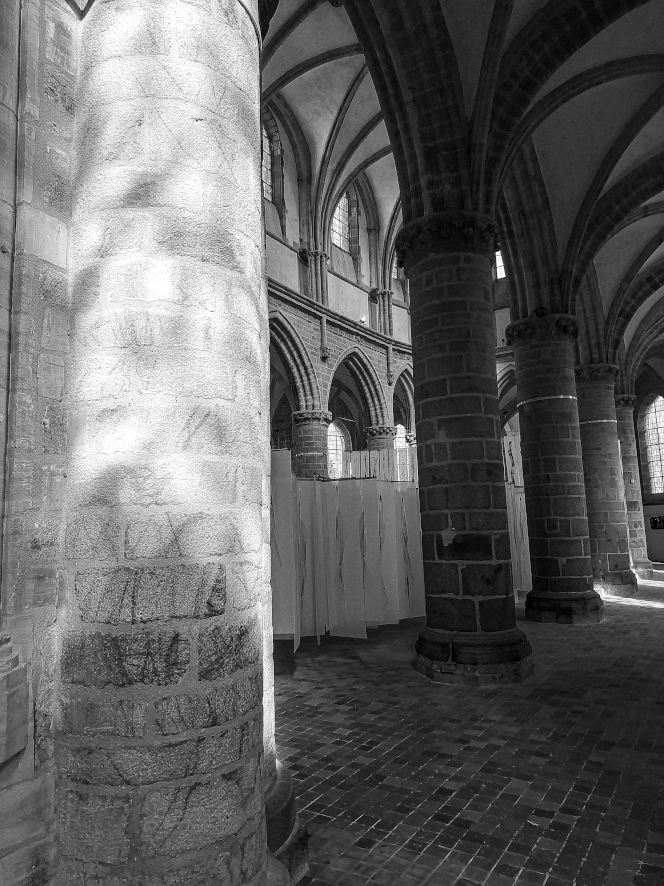
Cette forêt monumentale était composée de plus de 350 arbres disposés dans la partie centrale de l’église.
This monumental forest was made up of over 350 trees arranged in the central part of the church.
Questa foresta monumentale era composta da oltre 350 alberi disposti nella parte centrale della chiesa.
Cancan galerie, Villedieu-les-Poêles (2023)

La forêt, relativement modeste, a souligné les volumes de la galerie en marquant la différence de niveaux existant dans la pièce principale.
The relatively modest woodland emphasised the volumes of the gallery by marking the difference in levels in the main room.
Il bosco, relativamente modesto, ha enfatizzato i volumi della galleria segnando la differenza di livello nella sala principale.
102 Ter à Caen (2023)


Les arbres, d’environ quatre mètres de haut pour la plupart, reliaient les deux niveaux, permettant une vision de la forêt d’en bas, mais aussi d’en haut.
The trees, most of them around four metres high, linked the two levels, giving a view of the forest from below, but also from above.
Gli alberi, la maggior parte dei quali alti circa quattro metri, collegavano i due livelli, offrendo una vista della foresta dal basso, ma anche dall’alto.
Ecole Odette du Puigaudeau à Dakhla au Maroc (2022)

La forêt était installée dans le hall central de l’école, au carrefour de couloirs distribuant l’accès aux classes. Des pseudo chemins étaient en place pour favoriser la circulation des enfants.
The forest was set up in the central hall of the school, at the crossroads of the corridors leading to the classrooms. Pseudo paths were set up to encourage the children to move around.
Il bosco è stato allestito nell’atrio centrale della scuola, all’incrocio dei corridoi che portano alle aule. Sono stati allestiti dei pseudo-percorsi per incoraggiare i bambini a muoversi.
Ecole primaire Louis Aragon à Giberville (2020)
Eglise Saint-Nicolas à Caen (2019)
Cette forêt se composait de plus de 240 arbres entre 1,80m et 4m de haut et 25 ou 50cm de large.
This forest was made up of more than 240 trees between 1.80m and 4m high and 25 or 50cm wide.
Questa foresta era composta da oltre 240 alberi di altezza compresa tra 1,80 e 4 metri e larghezza di 25 o 50 cm.


Centre culturel les Fosses d’enfer à Saint-Rémy-sur-Orne (2018)


Le Sépulcre à Caen (2017)
